
Name-Based Case Searches
Need a name lookup? The Kansas District Court Public Access Portal is the main online route into Scott County District Court cases. Set the Court field to District. Pick Party Name as the search type. The helper wants names entered in the order Last Name, First Name. At least three letters of the last name are required. One letter of the first is required too. A trailing asterisk works for partial matches.
- Open the official Kansas Case Search address and review the access terms.
- Select District, then choose Party Name.
- Enter the name with the comma and use an asterisk only when a partial search is useful.
- Select Scott County and narrow by case type or filing dates when needed.
- Complete the live human check, open a likely match, and compare several fields before relying on it.
Common surnames can bury the case you want. Filters for county, case type, and date narrow the docket results without guessing at extra personal details.
Scott County Kansas Case Search Portal
Kansas gives the public one branded way in: the Kansas Case Search address. Court notices from 2025 still point to older names. Examples include prodportal.kscourts.gov and search.kscourts.gov. Treat those as legacy or transition addresses. An Azure-hosted interface carried the same accessible form during 2026. So the state has been moving its portal around. Start at the branded Kansas Judicial Branch address and let it redirect you. The official Kansas Case Search landing screen states the current gateway and its access notice.
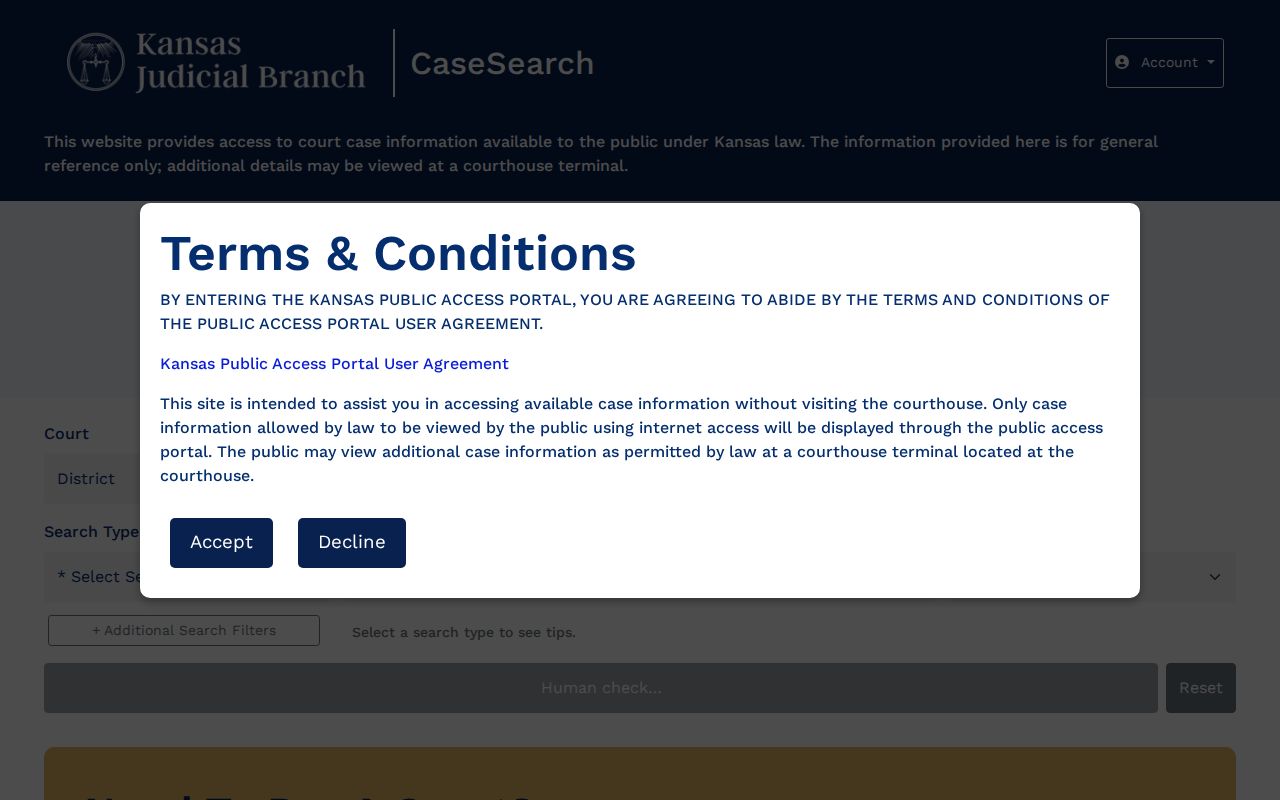
Before the Scott County case search portal opens, it asks you to accept its terms. The notice states that law limits what can be reached online, while a courthouse terminal may offer more public record detail than the portal itself.
Case Number Searches
An exact case number is often the cleanest key. For a Scott County court docket lookup, it beats a name search. Modern numbers pair the county prefix with a four-digit year. A case-type code and a six-digit sequence follow: SC-2022-CR-000001. That one is an instructional format, not a real case. Enter SC only if the court paper shows it. When a number carries no county code, set the Scott County selector first.
Older Scott County records may follow YYYY-CR-000001 or a compact legacy style like 2019CV25. The Kansas eCourt transition left several formats in play. One pattern cannot fit every historical court record. Copy the digits and punctuation straight from your notice and keep the four-digit year. Do not force an older number into the newer Odyssey pattern. If the exact number still fails, do not change digits at random. Ask the clerk of court to identify the right search form instead.
Scott County Search Form Controls
The form is built around four controls: Court, Search Type, Search Term, and County. Extra filters can tighten a broad result. Search and Reset buttons sit alongside a human check before each submission.
| Field | Type | Required | Scott County use |
|---|---|---|---|
| Court | Select | Not visibly marked | Choose District for the local trial court |
| Search Type | Select | Yes | Case Number, Party Name, Business Name, Party As Business Name, or Citation Number |
| Search Term | Text | Yes | Enter the complete number or properly formed name text |
| County | Select | Not visibly marked | Choose Scott County, acronym SC |
| Additional Filters | Expandable | No | Case type, DOB, and filing-date range |
Internally, the Scott selector carries the value 122550. You never type it. Just choose the county label.
Scott County Current Search Interface
The live form lets you filter by Criminal, Civil, Family, or Probate and Mental Health. Search types cover case number and party name. Business name, party as business name, and citation number are options too. Business Name is a search type of its own. It takes at least four characters. The helper suggests Acme* as a partial-search pattern. Do not put a company into the person-name field. The current official interface shows all of these controls.
Official Smart Search instructions describe wider criteria for registered users. A guest, or even an approved role, should not expect every advanced field to appear.
Case Search Results Explained
Match a result on several fields, never on a name alone. The official rules and guides lay out which fields to compare. They are the safe inventory for reading any docket result card.
| Case Number | The court identifier, including county prefix when the modern number has one. |
|---|---|
| Parties and Roles | Allowed names and their place in the case, subject to access rules. |
| Case Type | Criminal, civil, family, probate, or another official category. |
| Filed Date and Status | The opening date and current open, closed, or disposed state when displayed. |
| Judicial Officer and Attorneys | The assigned judge and listed counsel when public and available. |
| Events and Settings | Chronological event descriptions and allowed hearing dates. |
The events index is only a summary. A short entry is not the pleading, order, exhibit, or transcript behind it.
Two Ways to Search: County and State
Kansas Case Search and the courthouse terminal are two layers of one public-access system. Their scope differs, though. The web portal serves allowed case information remotely, plus some documents. A terminal at 303 Court Street can display public material withheld from remote view. That includes some older converted documents. Sealed and nonpublic material is off limits at both.
| Statewide portal | Scott County terminal and clerk |
|---|---|
| Remote access from one Kansas search | Local access at the courthouse |
| Allowed basic details and some documents | Public terminal-only and converted material may appear |
| Terms and human verification apply | Sign the local terminal sheet and follow counter controls |
| Not an official certified record | Clerk handles specific copy and certification requests |
The official district records explanation illustrates the web-versus-terminal distinction.
Rule 106B also says an electronic copy is not automatically the official court record.
Scott County Human Check Fallbacks
The current interface relies on human verification. The check can fail or block a search until it passes. Do not count on either anonymous or registered access working. The 2025 guide described registration and reCAPTCHA. The current page speaks of guest basic details plus ID.me for approved elevated users. Follow whatever prompt the docket portal actually shows you.
If the search will not run: verify the official address, terms, number format, county, spelling, comma, filters, and human check.
Then use the Scott County clerk, public terminal, phone, written request, or fax instead of repeated guessed submissions.
The clerk takes information and copy requests by phone, in person, in writing, and by fax. Local policy sets a three-business-day response expectation. A written Kansas Open Records Act request can go by mail. The state form lists email as a preferred delivery method. The clerk publishes no dedicated Scott County records email. Confirm the delivery option when you file the request.
Which Cases Stay Restricted
A blank result can mean several things. The case number may be mistyped. A human verification step may have failed. Some converted records sit only on courthouse terminals, and some case types or documents are excluded by law. So portal absence never proves a Scott County record is sealed.
Rule 22 keeps a long list of cases off the public portal: adoption, care and treatment, child in need of care, expunged, grand-jury, coroner-inquest, parental-bypass, and several protection-order types. Many documents stay hidden too, among them custody and support papers, citations, dissolution documents, juvenile records, presentence investigations, probable-cause affidavits, trial exhibits, and unexecuted warrants. A family filter may show up even while family documents stay closed.
Recheck the exact case number and its access category. Try the courthouse terminal for terminal-only material. Then ask the clerk about the lawful request path. No terminal and no records request can defeat a seal or confidentiality rule.
Scott County Docket Search Access Channels
Searching from home is just one way in. The Scott County clerk also takes case questions by phone, at the counter, in writing, or by fax. Inside the courthouse, the public terminal backs up the remote docket search. When you need a specific copy, a mailed Kansas Open Records Act request should name the case number, the document, the event date, and how you want delivery.
Match each tool to its job. The statewide portal handles allowed basic information. The terminal covers public material that is not shown remotely. The clerk answers copy and certification questions. A browser printout is never a certified record. Scott City municipal matters and federal cases run on their own routes.
Scott County Converted Record Searches
Kansas finished its statewide eCourt rollout in 2024, though no exact Scott County go-live date was established. Newer Odyssey numbers usually carry the SC prefix. Older ones may not. The 2025 portal and kiosk instructions give a warning. Converted documents from earlier systems may be missing from the web. They may still sit at a courthouse kiosk.
That history is why a valid older Scott County case may show only thin remote detail. Start online for the index. Keep the exact legacy number. Then move to the public terminal, or send the clerk a focused request for a named document. Kansas Judicial Branch eFiling at filer.kscourts.gov is a login-based filing tool, not a public search. Its domain changes and its worklist do not replace the docket portal.
Scott County and Federal Searches
Scott County District Court cases live in Kansas Case Search. Scott City ordinance and municipal traffic matters belong to the city municipal clerk, which publishes court and payment information but offers no public docket-search form. Call 620-872-5822 for that separate route. The Kansas Courts Central Payment Center can locate citations and payments, yet it is not the district register of action.
Federal cases are different. Federal district and bankruptcy matters run through PACER and federal CM/ECF. Kansas Case Search does not hold them. CourtListener's RECAP collection is a free public-interest alternative for some federal filings, though its coverage is incomplete and it is not a government record source. The CourtListener search interface shows that separate federal layer.
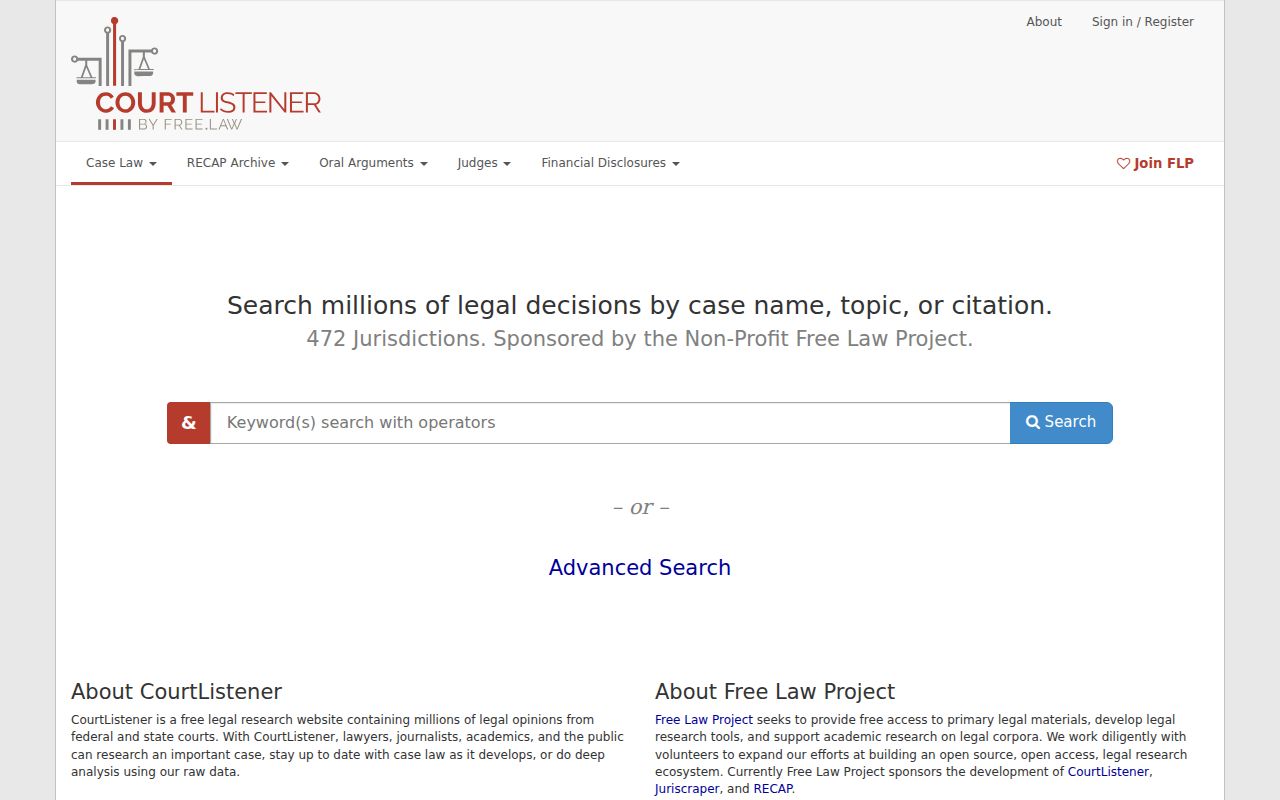
Pick the court system first. Choosing it up front keeps a correct search term out of the wrong database.